Kon'nichiwa, IT Teams! The ChromeOS Readiness Tool Launches Full Japanese Language Support
In today’s hyper-connected global economy, the shift to a cloud-native, secure, and flexible IT environment isn't just an advantage; it's a necessity. Organizations worldwide are embracing this transformation to boost productivity, improve security, and simplify management. At the forefront of this movement, Japan stands as a global leader in technological innovation and operational efficiency. However, for any global enterprise, the final barrier to adopting a new platform is often language. A tool that isn't fluent in the local team's language adds friction, creates ambiguity, and slows down strategic planning.
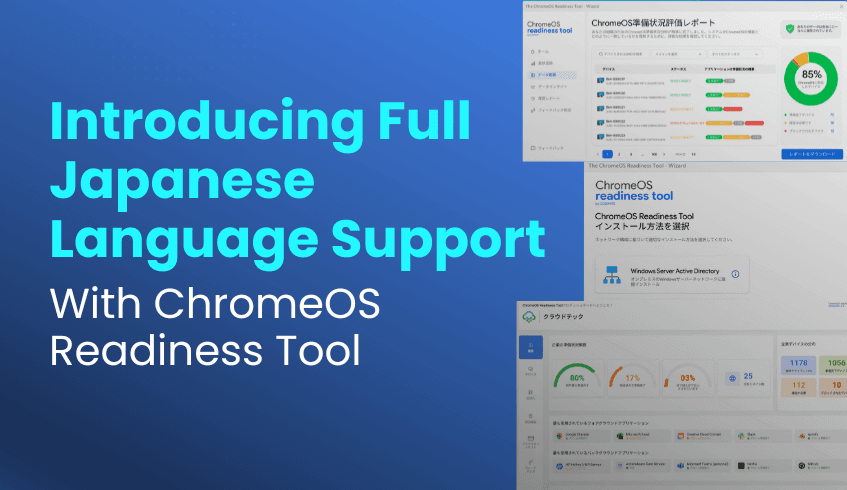
We believe that data-driven decisions should be clear and accessible to everyone. That’s why we are proud to announce a significant milestone in our commitment to global accessibility: The ChromeOS Readiness Tool now offers full, native Japanese language support. This isn't just a simple translation of the user interface. It's a deep localization effort designed to empower Japanese-speaking IT professionals, managers, and technology leaders to plan their migration to ChromeOS with unparalleled confidence and precision. This update removes linguistic barriers, ensuring that our partners in Japan can leverage the full power of the CRT's insights, natively and intuitively.
A Fully Accessible, Native-Language Assessment
This update provides a complete, seamless experience for our users in Japan. This is not just a translation of a few top-level menus; it is a comprehensive localization of the entire platform. This effort extends beyond the software interface itself to include all of our supporting user guides and technical documentation. We focused on ensuring that every piece of data, every configuration setting, and every report is now fully accessible in Japanese.
IT professionals can now interact with all critical components of the ChromeOS Readiness Tool natively. This includes:
The Client Applications (Installer and Report Generator): From the very first step of configuration, the experience is native. The Installer Application now guides Japanese-speaking administrators through every critical choice in their native language, from selecting the deployment flow and storage options to configuring the data collection period. Subsequently, the Report Generator application presents its comprehensive organizational overviews, device-specific insights, and downloadable reports entirely in Japanese, making local data analysis faster and more intuitive.
The Centralized Web Dashboards: Data clarity is paramount. Both the Pro Dashboard and the Partner Dashboard are fully localized. This means all readiness overviews, device and peripheral lists , Browser Insights, and even virtualization recommendations are presented in Japanese, allowing for instant analysis without translation.
The ChromeOS Readiness Tool Official Website: The journey starts with information, and that information is now fully accessible. The official website, the primary public resource for the tool, is localized. This allows IT leaders and potential partners in Japan to schedule demos, learn how the tool assesses compatibility, access the Resource Center, and even begin the partner journey in their preferred language.
The ChromeOS Readiness Tool is designed to be a secure, flexible, and user-friendly solution for assessing your application ecosystem, device compatibility, and peripheral integration. By providing a complete, native-language experience, we are making that solution significantly more powerful and intuitive for one of the world's most vital technology markets.
Driving Smarter, Faster Planning Through Total Clarity
The true value of this update lies in the removal of friction. When an IT team analyzes complex data, any language barrier acts as a "translation tax," like a constant mental burden that slows down comprehension and can lead to misinterpretation. By localizing the entire data pathway, we remove this tax and enable clearer, faster decision-making.
This localization effort extends to the most granular parts of the assessment, including domain readiness visuals and application categorization. When your IT team reviews your organization's application stack, every label, category, and status is now presented clearly in Japanese. This provides several immediate, powerful benefits:
Simplified Result Interpretation: Teams no longer need to pause to confirm the meaning of a specific technical term or category. The data is instantly understandable, allowing for more rapid and accurate conclusions.
Seamless Collaboration: The localized "Assessment Summaries" (reports) can be shared directly with Japanese-speaking stakeholders, department heads, and executives who prefer the Japanese language. This streamlines the approval process and makes sure everyone is aligned on the migration strategy.
Reduced Risk of Error: With all "Configuration Options" in Japanese, the risk of misconfiguring an assessment or misinterpreting a critical data point plummets. This leads to higher-quality data and, ultimately, a more successful deployment.
By removing the language barrier, Japanese IT teams can now focus 100% of their energy on what truly matters: the data itself. This allows them to move more quickly from analysis to insight to a concrete, actionable migration plan, all while using the same powerful, secure assessment trusted by organizations worldwide.
The Future is Accessible
This launch is more than just a new feature; it's a reflection of our core belief that digital transformation should be accessible to everyone. The ChromeOS Readiness Tool enables organizations to build a modern, secure, and sustainable IT future. By providing full Japanese language support, we ensure that users in Japan can lead the charge without compromise.
We are excited to see how this enhancement will empower more organizations in Japan to unlock the full potential of their data, align their technology strategy with their business goals, and confidently embrace the security, speed, and simplicity of ChromeOS.