4 Real Attack Case Studies Solved by Chrome Enterprise Premium
In today’s landscape, a single browser tab can be the difference between a productive afternoon and a multi-million dollar data breach. For most employees, the browser is where they live, accessing everything from Salesforce and Jira to sensitive internal financial dashboards.
Traditional security stacks often struggle to see what happens inside that tab. To help bridge the gap between abstract features and concrete security, we’ve mapped Chrome Enterprise Premium to four common, real-world attack scenarios that keep IT leaders up at night.
1. The Phishing-Led Compromise
The Scenario: An employee receives a highly convincing "urgent" email about a payroll update. They click the link, which leads to a pixel-perfect replica of the company’s login page. Thinking they are authenticating, they hand over their credentials to a malicious actor.
The Solution with Chrome Enterprise Premium:
Real-time URL Scanning: While standard browsers rely on static lists, Chrome Enterprise Premium uses AI-powered, real-time scanning to identify zero-day phishing sites the moment they are visited.
Password Reuse Detection: If an employee inadvertently enters their corporate password on an unvetted site, the browser triggers an immediate warning and can block the submission, stopping the credential theft in its tracks.
2. BYOD Credential Abuse
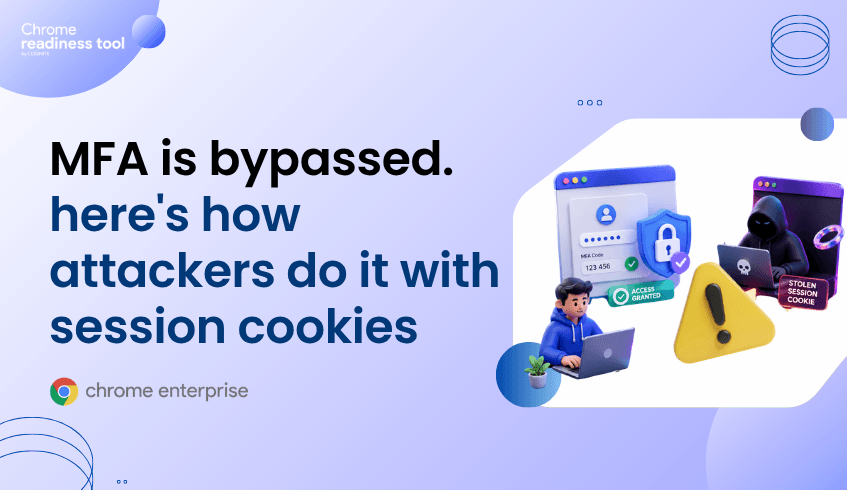
The Scenario: A contractor uses their personal, unmanaged laptop to access the company’s Confluence and Bitbucket instances. Unknown to them, their personal machine is infected with infostealer malware that captures their session cookies, allowing an attacker to bypass Multi-Factor Authentication (MFA) and gain full access to the source code.
The Solution with Chrome Enterprise Premium:
Context-Aware Access: Using Zero Trust principles, the system evaluates the device's security posture. If a login attempt originates from an unmanaged or "low-trust" device, access to sensitive apps can be restricted or denied entirely.
Agentless Control: You can enforce security policies, like blocking downloads or disabling copy-paste, directly through a managed Chrome Profile, protecting data even on hardware you don't own.
3. The Insider Data Theft
The Scenario: A departing salesperson attempts to download a massive client list from Salesforce or copy-paste confidential pricing strategies into a personal Gmail draft before their final day.
The Solution with Chrome Enterprise Premium:
Advanced Data Loss Prevention (DLP): IT can set granular rules that recognize sensitive data types (like PII or financial patterns). The browser can then block the upload, download, or printing of that content in real-time.
Deep Content Inspection: Unlike legacy tools that only look at file names, Chrome Enterprise Premium scans the actual content of files and clipboard actions to ensure hidden sensitive data doesn't leave the perimeter.
4. The Malicious Extension Trap
The Scenario: An employee installs a "productivity" extension found in a third-party store to help manage their Jira tickets. The extension works as advertised but secretly records every keystroke and exfiltrates session tokens for HR and ERP platforms.
The Solution with Chrome Enterprise Premium:
Extension Telemetry & Management: IT gains total visibility into every extension across the fleet. High-risk permissions are flagged, and unverified add-ons can be blocked centrally.
Malicious Behavior Detection: The browser monitors for anomalous extension activity, such as an add-on attempting to scrape authentication tokens, and provides the SOC team with the telemetry needed to remediate the threat instantly.
Auditing Your Environment with the Chrome Readiness Tool
Before you can defend against these attacks, you need to know where your "blind spots" are. The Chrome Readiness Tool acts as your diagnostic command center, providing the data needed to justify a move to Chrome Enterprise Premium.
Custom Readiness for Unverified Domains: The tool automatically identifies and displays a tag for domains or extensions that might be unsafe. It empowers administrators to mark these as unsafe directly from the report generator, creating a custom readiness baseline for the organization.
Session Theft Vulnerability: The tool specifically flags vulnerabilities with session hijacking, identifying situations where sessions may have already been compromised.
Extension Inventory: See the Extension name, version, ID and installed browser across your fleet and identify "Shadow IT" before it becomes an entry point for an attacker.
By combining the diagnostic insights of the Chrome Readiness Tool with the enforcement power of Chrome Enterprise Premium, organizations stop speaking in abstracts and start building a concrete, resilient defense where work actually happens.