Agentic Workflow Readiness: Turning Manual Work Into Automation Opportunity
Summary
Enterprise teams know repetitive work is slowing them down, but most organizations do not know which workflows should be automated first. Manual processes often span email, spreadsheets, documents, calendars, SaaS tools, and internal applications, making them hard to measure and even harder to prioritize. Agentic Workflow Readiness in Chrome Readiness Assessment helps close that gap by surfacing repetitive, multi-step workflows and identifying where AI-driven automation can create the most business value. It helps teams move from guessing about automation opportunities to planning with real usage insight.
Why is workflow automation still difficult for enterprises?
The problem is not a lack of automation tools. The problem is knowing where to apply them.
Most enterprises already have teams experimenting with AI agents, workflow automation, scripts, and no-code tools. But without visibility into how work actually happens across devices and applications, automation becomes fragmented. One team may automate a task that saves minutes, while a larger, more repetitive process remains untouched.
This creates several business pain points:
Manual workflows continue to consume employee time.
Operations teams struggle to identify high-impact automation opportunities.
IT teams lack a clear view of which applications are involved in recurring workflows.
Business leaders cannot easily estimate where automation will reduce cost or improve efficiency.
Automation decisions are often based on assumptions instead of real usage patterns.
As organizations move toward agentic AI, this visibility gap becomes more important. AI agents can automate complex work, but only when the organization understands which workflows are repeatable, frequent, and technically feasible to automate.
How Chrome Readiness Assessment Helps Identify Automation Opportunities
Chrome Readiness Assessment helps organizations move from uncertainty to visibility.
Before teams invest in AI agents or automation platforms, they need to understand how work is actually happening across the enterprise. Which workflows are repeated every day? Which ones consume the most time? Which applications are involved? Which processes are good candidates for automation?
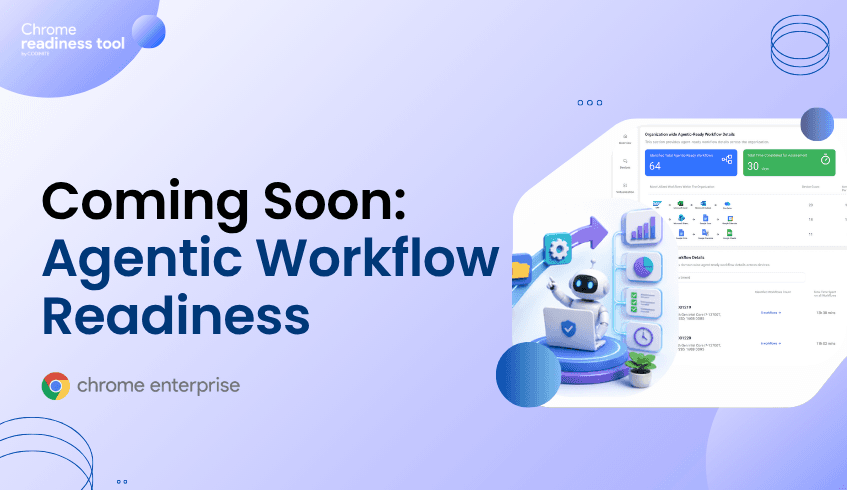
The Agentic Workflow Readiness feature expands the value of Chrome Readiness Assessment by giving IT and business leaders a clearer view of repetitive, multi-step workflows across devices and applications.
Instead of relying on manual interviews, assumptions, or scattered process documentation, CRA helps surface workflow patterns from real application usage. It identifies recurring sequences across desktop and browser-based activity, highlights time spent on those workflows, and shows which workflows may be ready for automation.
This makes CRA a practical starting point for agentic AI adoption.
With CRA, organizations can:
Discover repetitive workflows across users and devices.
Understand where employees spend time on manual processes.
Identify high-impact workflows based on frequency and time spent.
See whether workflows are better suited for Google Workspace Studio, n8n, or both.
Prioritize automation opportunities before committing implementation resources.
The key benefit is clarity. CRA does not automate workflows directly. It helps organizations understand where automation can deliver value, which workflows are feasible, and which automation path may be most appropriate.
That turns Chrome Readiness Assessment from a readiness tool into a strategic automation planning layer. It helps leaders answer the question that often blocks AI adoption: Where should we automate first?
Where do Google Workspace Studio and n8n fit?
Agentic Workflow Readiness does not automate workflows directly. It helps organizations identify and plan the right automation path.
For workflows centered around Google Workspace applications such as Gmail, Drive, Calendar, and related Workspace activity, Google Workspace Studio is positioned as a natural automation path. Google describes Workspace Studio as a way to automate work with Gemini-powered workflows and create AI agents for Workspace processes.
For workflows that span multiple applications, SaaS platforms, or integration-heavy environments, n8n can support broader workflow automation. n8n describes itself as a workflow automation platform that combines AI capabilities with business process automation and supports a large ecosystem of integrations.
This distinction helps teams avoid a common automation mistake: choosing a tool first and searching for use cases later. Agentic Workflow Readiness reverses that approach. It starts with real workflow behavior, then helps map the workflow to a suitable automation option.
Why does workflow visibility matter before adopting AI agents?
AI agents are powerful, but they need the right operating context.
Without workflow visibility, organizations may automate isolated tasks while missing the bigger process. They may also underestimate integration complexity, duplicate automation work across teams, or invest in automations that do not address meaningful business pain.
Agentic Workflow Readiness helps create that missing context. It gives decision-makers a clearer understanding of how work moves across applications and where repeatable patterns exist.
This is especially useful for:
IT leaders evaluating where agentic automation should begin.
Operations teams looking to reduce repetitive manual effort.
Business leaders seeking cost optimization opportunities.
Transformation teams building an AI automation roadmap.
Security and governance stakeholders who need visibility before automation expands.
The result is a more disciplined path to agentic AI adoption. Teams can identify what is ready, understand which workflows are worth prioritizing, and choose automation technologies with greater confidence.
How does this reduce operational cost?
Operational cost is not only about software spend. It is also about the time employees spend repeating the same multi-step processes every day.
When repetitive workflows remain manual, organizations absorb hidden costs through slower execution, duplicated effort, avoidable handoffs, and inconsistent process quality. These costs are difficult to manage when leaders cannot see where the time is going.
Agentic Workflow Readiness helps make those costs visible by showing where repetitive workflows exist and how much time they consume. That visibility allows teams to prioritize automation where it can reduce manual effort and improve process efficiency.
The business impact is practical:
Employees spend less time on repetitive coordination.
Teams can focus automation resources on high-value workflows.
Leaders gain a clearer view of where manual work is creating drag.
IT can plan automation adoption with better evidence.
Organizations can move toward agent-driven operations without relying on guesswork.
What makes this different from a traditional workflow audit?
Traditional workflow audits are often manual, slow, and incomplete. They rely on interviews, surveys, workshops, or process documentation that may not reflect how work actually happens.
Agentic Workflow Readiness is designed to support a more usage-informed approach. It analyzes workflow patterns across desktop and browser-based activity, including web application usage, to identify repeatable sequences and automation opportunities.
That makes it more practical for modern enterprises, where workflows often span local applications, browser-based SaaS tools, and Google Workspace applications.
Instead of asking, “What do teams say they do every day?” organizations can begin asking, “Which workflows are repeatedly happening across our environment, and which ones are ready for automation?”
What should organizations expect from this feature?
Organizations should view Agentic Workflow Readiness as a planning and visibility capability for automation strategy.
It is not a tool for automatically deploying agents. It is not real-time orchestration. It does not create custom workflows on behalf of users. Its role is to help administrators and decision-makers identify automation-ready workflows and understand where tools like Google Workspace Studio or n8n may fit.
That makes it especially valuable at the beginning of an automation journey. Before scaling agentic AI, organizations need to know where automation makes sense. Agentic Workflow Readiness gives them a clearer way to make that decision.
FAQ
What is Agentic Workflow Readiness?
Agentic Workflow Readiness is a Chrome Readiness Assessment feature that helps organizations identify repetitive workflows that may be suitable for AI-driven automation.
Does Agentic Workflow Readiness automate workflows automatically?
No. It helps identify and recommend automation opportunities, but it does not execute, deploy, or orchestrate workflows automatically.
Which automation platforms does it help evaluate?
It helps map automation opportunities to Google Workspace Studio for Google ecosystem workflows and n8n for cross-application or integration-heavy workflows.
Who benefits most from this feature?
IT admins, operations leaders, transformation teams, and business decision-makers benefit because the feature helps them prioritize automation based on real workflow patterns.
Why is this important for agentic AI adoption?
Agentic AI works best when organizations know which workflows are repetitive, valuable, and feasible to automate. Agentic Workflow Readiness helps provide that foundation.
Closing CTA
Manual work is often hidden inside everyday application usage. Agentic Workflow Readiness helps bring that work into view, so organizations can identify high-impact automation opportunities before investing time and resources into AI agents.
Start by using Chrome Readiness Assessment to understand where repetitive workflows exist across your environment. Then use those insights to prioritize the workflows best suited for Google Workspace Studio, n8n, or future agentic automation initiatives.