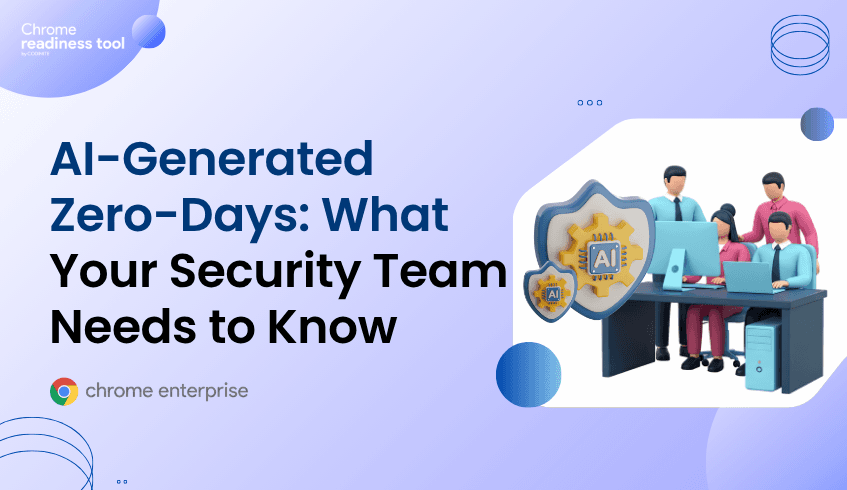
AI-Generated Zero-Days: What Your Security Team Needs to Know Now
A Structural Shift in How Vulnerabilities Are Found
The emergence of AI-assisted vulnerability research has altered the economics of zero-day discovery in ways that directly affect enterprise browser security planning. What previously required specialized expertise and significant manual effort, reviewing source code, fuzzing inputs, and analyzing crash reports, can now be assisted or partially automated using large language models and AI-driven fuzzing tools. The practical result is that zero-day vulnerabilities in browser components are being identified at higher frequency and with lower barriers to entry.
This shift matters for enterprise security teams because it compresses the timeline between a vulnerability existing and that vulnerability being discovered, weaponized, and used in attacks. The assumption that a zero-day requires nation-state resources to develop is increasingly outdated. AI tooling has made aspects of vulnerability research accessible to a much broader range of threat actors.
The browser is the primary target in this environment because it represents the convergence of user credentials, session tokens, enterprise application access, and sensitive data, all within a single process that is exposed to external content by design.
Where the Risk Comes From
AI-assisted fuzzing can identify exploitable crash conditions in browser JavaScript engines and rendering components faster than traditional research methods
Large language models can assist in converting discovered crash conditions into working proof-of-concept exploits, reducing the time from discovery to weaponization
Browser credential stores and session tokens are high-value targets for zero-day exploitation because they provide immediate access to enterprise applications without requiring separate credential theft
Outdated browsers running across managed and unmanaged enterprise devices represent a persistent attack surface for both new and historical zero-days
Extension supply chain compromise allows attackers to deliver zero-day payloads through trusted extension update channels rather than requiring direct browser exploitation
Chrome Enterprise Premium: Defense Depth Against Unknown Vulnerabilities
Chrome Enterprise Premium provides multiple enforcement layers that limit zero-day impact even when the specific vulnerability is unknown. Site isolation ensures that even a successful exploit of a browser rendering component cannot automatically access session tokens and credentials associated with other origins in the same session. This architectural boundary constrains the scope of what an attacker gains from a zero-day exploit.
App-bound encryption protects stored credentials and session tokens at the browser process level. An attacker who successfully exploits a zero-day in a browser component gains a more limited foothold than in a browser without this protection, because credential extraction requires additional steps that CEP's controls are designed to obstruct.
CEP's extension governance capabilities allow organizations to enforce allowlist-based extension policies, blocking the delivery of zero-day payloads through compromised extension update channels before they reach end-user devices.
Understanding Risk with Chrome Readiness Tool
Browser Insights provides the fleet-wide visibility that security teams need to assess zero-day exposure. Session theft vulnerability is evaluated based on browser version: current browsers are confirmed as protected against known session theft mechanisms, while outdated browsers are flagged as not protected and represent the highest priority for remediation ahead of any zero-day campaign.
The tool surfaces installed extensions across Chrome, Edge, Firefox, Vivaldi, Brave, and Opera, identifying unverified and outdated extensions that represent both supply chain risk and potential zero-day delivery vectors. Security teams can use device-level drill-down to investigate specific machines where extension and browser version risk combine to create elevated exposure.
Unsecured domain access is flagged within Browser Insights as an additional risk signal. Non-HTTPS and restricted domains are common channels for exploit delivery, and their presence in the device risk profile indicates that CEP enforcement should be prioritized. A device is classified as secure when it has no unverified extensions and no access to restricted or flagged domains.
Where CEP Accelerator Adds Value
CEP Accelerator functions as a planning layer inside Browser Insights, connecting observed risk signals to the CEP capabilities that provide the most relevant defense against AI-generated zero-day threats.
For zero-day risk planning, CEP Accelerator helps security teams understand which devices carry the highest exposure based on browser version gaps and extension risk, and maps those findings to the specific CEP controls, including site isolation, app-bound encryption, and extension allowlist enforcement, that should be deployed first. It translates Browser Insights visibility into a prioritized enforcement action plan.
Preparing for Vulnerabilities That Have Not Been Announced Yet
Zero-day threats by definition arrive before defenses are tuned for them. The organizations best positioned to limit their impact are those that have deployed enforcement controls that constrain exploit impact without requiring vulnerability-specific knowledge. Chrome Enterprise Premium provides that enforcement foundation. Browser Insights identifies where it is most urgently needed.
Start by identifying risks with Browser Insights to understand where your device fleet is most exposed to the next browser-targeted zero-day campaign.