Beyond the Password: How Context-Aware Access Stops Credential Abuse
Imagine a valid username and password for your company’s financial controller are entered into your Salesforce login page. On paper, the "identity" is verified. However, the login isn't coming from the controller’s managed corporate laptop in London; it is coming from an unmanaged, personal device in a different country, a device that happens to be infected with a silent credential-stealer.
In a traditional security model, that password is a golden ticket. But in a modern, identity-aware environment, the password is only one piece of a much larger puzzle. This is the core of Context-Aware Access, a strategy designed to stop the "BYOD breach" before it even begins.
The Vulnerability of "Identity-Only" Security
Many organizations have moved to the cloud, but their security logic remains tethered to the past. They rely on "Identity and Access Management" (IAM) to prove who a person is, but they neglect the "Context" , the "how," "where," and "what" of the connection.
The Managed vs. Unmanaged Gap: When employees or contractors use personal devices (Bring Your Own Device), they often bypass the security controls of the corporate network.
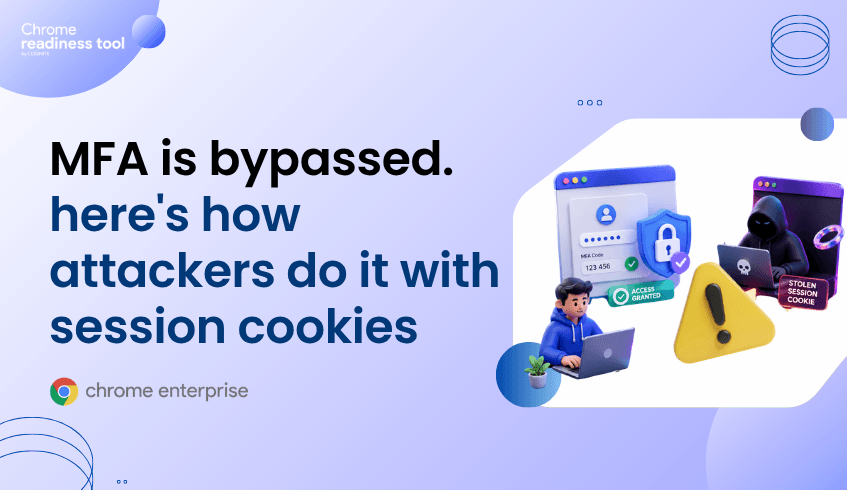
The MFA Bypass: Modern attackers don't just steal passwords; they steal session cookies. If an attacker clones a session from a personal laptop, they can often bypass Multi-Factor Authentication entirely.
The Shadow Device Risk: An unmanaged device may have outdated security patches or active malware, turning a legitimate login into a backdoor for ransomware.
Chrome Enterprise Premium: The Context Engine
Chrome Enterprise Premium solves this by transforming the browser into a dynamic security gatekeeper. Instead of a binary "Yes" or "No" based on a password, the system evaluates the context of the request in real-time.
IT leaders can implement a solution-focused defense that adapts to the risk level of each session:
Continuous Security Posture Checks: Before granting access to sensitive apps like Jira or Workday, the browser checks the device's health. Is the OS updated? Is the screen lock enabled? Is it a managed corporate device?
Adaptive Access Levels: If a user logs in from a personal laptop, you don't have to block them entirely. You can grant "Restricted Access" allowing them to view data in the browser while blocking the ability to download, print, or copy-paste sensitive information.
Geographic and Network Fencing: Access can be gated based on the user's location or IP reputation, ensuring that high-value resources are never exposed to high-risk regions or suspicious networks.
Auditing Your Entry Points with the Chrome Readiness Tool
To build an effective context-aware policy, you first need to see who is knocking at your door. The Chrome Readiness Tool provides the diagnostic visibility required to identify your organization's highest-risk access points.
The Chrome Readiness Tool highlights the vulnerabilities that lead to credential abuse:
Session Theft Vulnerability: The tool shows session hijacking risks. It identifies instances where active login cookies may have been compromised, a critical signal that a "verified" identity may actually be an attacker.
Unverified Domain and Extension Tagging: To prevent "Shadow IT" from becoming a bridge for attackers, the tool displays a tag for domains or extensions that might be unsafe. Administrators can mark these as unsafe directly from the report generator, preventing unvetted tools from interacting with corporate credentials.
Device Integrity Mapping: See a breakdown of browsers that are running on outdated versions, allowing you to prioritize which teams need the strictest context-aware policies.
Shifting to Zero Trust
The story of the 2:00 AM login doesn't have to end in a breach. With Chrome Enterprise Premium, that login attempt is flagged because the context doesn't match the identity. The browser sees the unmanaged device and the suspicious location, and it automatically denies access long before the attacker can move laterally through your network.
By using the Chrome Readiness Tool to audit your environment and Chrome Enterprise Premium to enforce context-aware controls, you ensure that your data is protected by more than just a password. You are protecting it with the full power of real-time intelligence.