Closing the Browser Blind Spot: The Missing Piece in Your Security Stack
Imagine a Security Operations Center (SOC) on a Friday afternoon. An alert triggers: sensitive data has left the network. The team springs into action, pulling logs from the Endpoint Detection and Response tool, checking the firewall, and reviewing the Cloud Access Security Broker reports.
They can see the what and the where; a 50MB PDF was uploaded to an external site. But they hit a wall when it comes to the how. Was that file a legitimate download from the company's Jira board? Was it sensitive intellectual property copied directly from a SharePoint folder? Or was it moved during an unauthorized browser session that traditional tools simply could not see?
This is the browser blind spot. Even with a robust security stack, most SOC teams remain blind to the granular actions occurring inside the browser, where modern work happens.
Why Traditional Tools Fall Short
For years, security has been built around the perimeter and the endpoint. However, as applications move to the cloud, the perimeter has shifted to the browser tab. Traditional tools often see the browser as a single process, failing to distinguish between a user checking the news and a user extracting core business data.
The EDR Gap: While Endpoint Detection and Response is excellent at catching malware executing on a hard drive, it often struggles to provide telemetry on in-browser events like a user copying text from a secure SaaS app into a personal webmail draft.
The Network Limit: Firewalls and encrypted traffic inspectors can see that data is moving, but they lack the context of the user’s intent or the specific web-based workflow they were following.
Closing the Gap with Chrome Enterprise Premium
To eliminate this blind spot, security must move directly into the browser. Chrome Enterprise Premium acts as a high-fidelity telemetry layer, providing the SOC team with the missing context needed to reconstruct the full chain of an incident.
By integrating security at the browser level, organizations gain a solution-focused approach to incident response:
Granular Event Telemetry: Instead of seeing generic web traffic, security teams get detailed logs on specific browser actions such as file uploads, downloads, and even copy-paste events across all web applications.
Direct Data Visibility: IT can identify exactly which document was moved and which platform it originated from, whether it was Salesforce, Slack, or an internal reporting tool.
Context-Aware Enforcement: Beyond just seeing the problem, Chrome Enterprise Premium allows teams to set proactive policies. If a file is deemed sensitive, the browser can block the upload in real-time based on the user identity and the security posture of the device.
Auditing Your Exposure with the Chrome Readiness Tool
Before a breach occurs, IT leaders must understand where their visibility gaps are widest. The Chrome Readiness Tool serves as the diagnostic gateway, allowing organizations to audit their fleet and identify the technical risks that contribute to the browser blind spot.
The Chrome Readiness Tool highlights key areas where security posture may be lacking through specialized features:
Unverified Domain and Extension Tagging: The tool automatically displays a tag for domains or extensions that might be unsafe. This empowers administrators to review and mark these entities as unsafe directly from their end, creating a customized blocklist based on real-time organizational data.
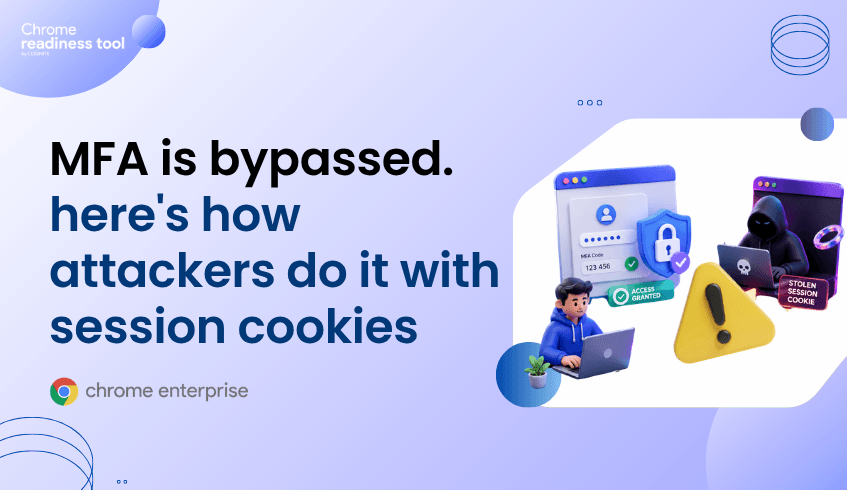
Session Theft Identification: The tool flags session theft vulnerabilities where attackers steal active login cookies to bypass Multi-Factor Authentication, a common vulnerability that often goes undetected by traditional network security.
Version Integrity: It maps out which browser versions are being used across the fleet, ensuring the entire organization is patched against known threats.
From Blind Spots to Total Visibility
In the modern enterprise, a security strategy that ignores the browser is incomplete. By utilizing the Chrome Readiness Tool to map out risks and identify unverified domains, and using Chrome Enterprise Premium to enforce deep telemetry and control, SOC teams can finally close the browser blind spot.
When you can see exactly what happens inside the tab, you do not just respond to breaches faster,you stop them from happening in the first place.