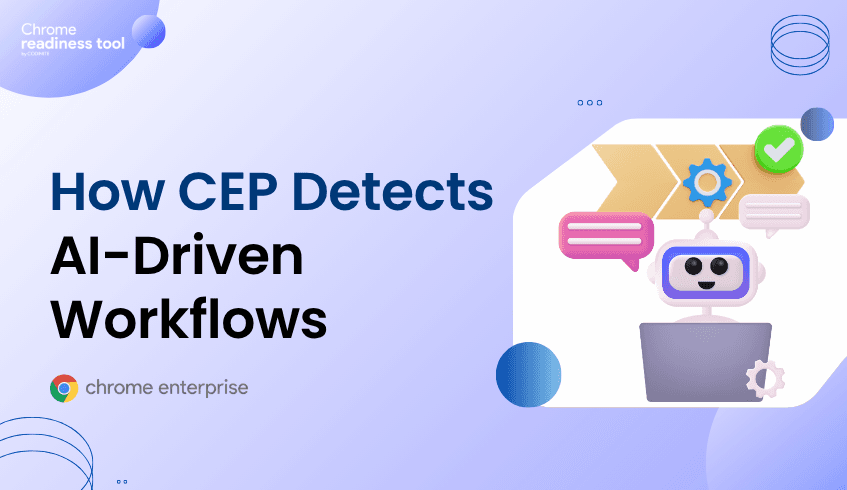
How CEP Detects AI-Driven Workflows Versus Human Activity
When the Browser Can No Longer Assume a Human Is Driving
Enterprise browser security has historically been built around one assumption: a human is operating the browser. Behavioral analytics, anomaly detection, and access controls have been calibrated to human interaction patterns. AI-driven workflows break that assumption. Automated agents navigate applications, submit data, and access resources at speeds and scales that fall outside normal human behavior baselines, creating both detection gaps and new risk categories.
For security teams, the inability to reliably distinguish AI-driven activity from human activity is not just a monitoring problem. It is a control problem. If an enterprise cannot differentiate a sanctioned AI workflow from a malicious automated process operating inside a legitimate browser session, it cannot enforce meaningful restrictions on what that activity is permitted to do.
Chrome Enterprise Premium addresses this challenge through browser-level policy enforcement that applies uniformly to all activity, regardless of whether it is human or automated, and through administrative controls that allow organizations to govern what automation is permitted to operate within the browser environment.
Where the Risk Comes From
Automated agents operating inside authenticated browser sessions inherit the same access rights as the user, including access to sensitive SaaS applications and stored credentials
AI-driven data access at scale can exfiltrate significantly more information per session than human activity, but may not trigger volume-based anomaly detection if the agent operates within normal request rate limits
Malicious automation that mimics sanctioned AI workflow patterns can evade behavioral detection by blending with expected agent activity
Extension-based automation tools may not be visible to enterprise security stacks if they operate within the browser process and do not generate separate network traffic
Session theft targeting AI agent credentials allows attackers to impersonate an automated workflow and operate within its access scope without detection
Chrome Enterprise Premium: Policy That Governs All Browser Activity
Chrome Enterprise Premium enforces policy at the browser layer, which means it applies to all processes operating within that context, including AI agents. App-bound encryption ties credential and session token access to the specific browser process, preventing automated scripts or external tools from extracting session material even when they operate within an authenticated session.
CEP's extension management capabilities allow organizations to define an allowlist of verified extensions, blocking unverified automation tools from operating within the enterprise browser environment. This provides direct governance over what automation frameworks are permitted to interact with browser sessions and enterprise application data.
Administrative reporting surfaces unusual extension activity and policy violations regardless of whether the source is human or automated, giving security teams the operational visibility needed to identify unauthorized agent activity.
Understanding Risk with Chrome Readiness Tool
Browser Insights provides the foundational visibility needed to assess AI workflow risk across the device fleet. The tool reports installed extensions across Chrome, Edge, Firefox, Vivaldi, Brave, and Opera, flagging unverified and outdated extensions that may be introducing unauthorized automation capabilities into the enterprise environment.
Session theft vulnerability assessment is based on browser version. Current browsers are confirmed as protected; outdated browsers are flagged as not protected, representing risk that automated session hijacking can exploit. Browser Insights also surfaces access to non-HTTPS and restricted domains that AI-driven workflows should not be reaching.
Device-level drill-down allows security teams to investigate specific machines where the combination of unverified extensions and outdated browsers creates the highest risk of unauthorized automated activity.
Where CEP Accelerator Adds Value
CEP Accelerator functions as a planning and visibility layer inside Browser Insights. It does not detect AI-driven activity directly or enforce policies autonomously. What it does is connect the risk signals observed in Browser Insights, such as unverified automation extensions or vulnerable browser versions, to the specific CEP capabilities that govern those risks.
For teams assessing AI workflow security, CEP Accelerator helps prioritize enforcement: which devices need immediate browser updates, which extension policies need to be deployed first, and where CEP's session protection controls will have the highest impact. It turns visibility into an actionable enforcement roadmap.
Governing the Automated Browser Enterprise
The boundary between human and AI-driven browser activity will continue to blur as enterprise adoption of agentic tools accelerates. Browser security strategy needs to account for this shift at the policy layer, not just at the detection layer. Chrome Enterprise Premium provides that policy foundation. Browser Insights provides the visibility to identify where it is needed most.
Start by identifying risks with Browser Insights to understand where unauthorized automation and session vulnerability intersect across your device fleet.