How Chrome Enterprise Browser Helps Reduce Session Hijacking Risks
The enterprise browser is now the primary gateway for nearly every workflow. SaaS platforms, identity providers, and confidential data all flow through a single point: the browser. This convenience comes with increased risk, as attackers increasingly target browsers using malicious extensions or stolen tokens to hijack active sessions. Traditional network defenses cannot protect this layer, making session hijacking one of today’s most damaging and hard-to-detect threats.
Organizations are responding with a browser-centric, Zero Trust approach, leveraging Device-Bound Session Credentials (DBSC) and Chrome Enterprise Premium governance to reinforce security where work actually happens.
Strengthening Sessions with Device-Bound Session Credentials (DBSC)
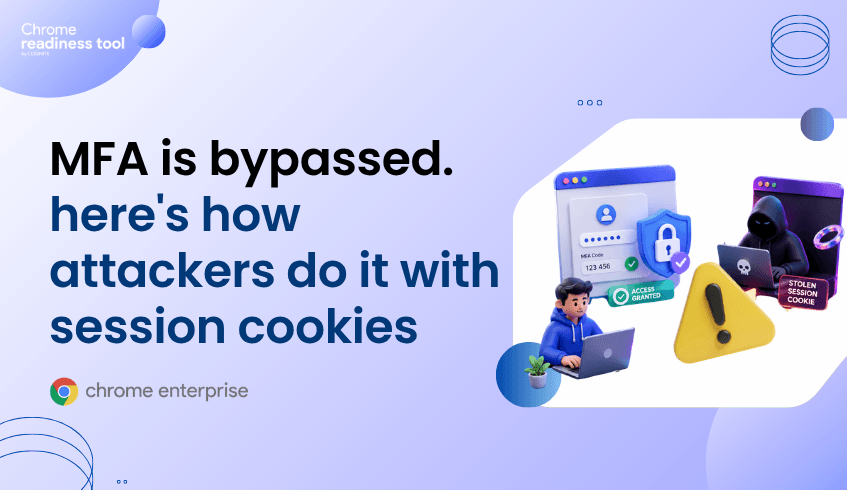
Session hijacking exploits a simple weakness: most authentication tokens act as bearer tokens. If stolen, they can be replayed from any device, bypassing passwords or multi-factor authentication..
DBSC replaces portable tokens with a private key stored securely on each device:
Unique to the device
Non-exportable
Protected by hardware-backed storage
The browser periodically proves possession of this key to maintain the session. Stolen tokens cannot be reused, shifting session security from “whoever has the token gets in” to “only the device with the key can authenticate”. This aligns directly with Zero Trust principles by validating both identity and device state.
Browser Governance with Chrome Enterprise Premium
DBSC secures the session, but browser governance prevents risky interactions and local attack paths. Chrome Enterprise Premium addresses this in two key ways:
1. Controlling Extension Risks
Extensions remain a common attack vector, often requesting access to:
All URLs
Network traffic interception
Cross-service visibility
Premium lets IT teams:
Block dangerous permissions automatically
Allow only approved extensions
This reduces the paths attackers can exploit to steal session data.
2. Managing Outbound Connections
Even if an extension behaves unexpectedly, attackers still need to send data externally. Chrome Enterprise Premium enforces URL governance:
Blocks known malicious domains
Prevents suspicious extension communication
Restricts activity to trusted destinations
Removes compromised extensions automatically
These policies support a Zero Trust mindset, limiting what malware can do even if activated.
A Browser-Centric Zero Trust Model
Combining DBSC and Chrome Enterprise Premium creates layered defenses at the intersection of identity, applications, and data:
Verify explicitly: DBSC validates identity and device ownership continuously
Use least-privileged access: Extension policies restrict unnecessary capabilities
Assume breach: URL controls limit external communication from suspicious activity
Advancing Security with the ChromeOS Readiness Tool
Understanding your environment is the first step to stronger browser security. The ChromeOS Readiness Tool helps IT teams assess current conditions before applying policies or planning OS transitions.
Assessing Extension Risks
Session hijacking often begins with risky extensions. The tool provides Browser Insights that show:
All active extensions across the fleet
Unauthorized or high-risk extensions
This enables IT teams to enforce policies based on actual data.
Identifying Devices Ready for ChromeOS
Chrome Enterprise Premium strengthens security on any OS, but pairing it with ChromeOS Flex maximizes protection. The tool evaluates fleet compatibility, helping organizations modernize legacy hardware with:
Built-in ransomware resistance
Default sandboxing
Native support for DBSC and enterprise policies
This step transitions security from the browser to the device itself.
Automating Discovery to Support Policy Decisions
Shadow ITapplications used without IT oversight can disrupt workflows when strict policies are applied. The ChromeOS Readiness Tool automates discovery while protecting privacy, generating an inventory of applications and browser extensions.
Key actions for IT teams:
Audit applications: Identify critical apps and whitelist their domains.
Audit extensions: Whitelist required host domains to maintain functionality.
Plan virtualization: Ensure legacy apps running through virtualization platforms have the necessary domain access.
This ensures whitelists are data-driven, reducing disruption while maintaining security.
By combining DBSC, Chrome Enterprise Premium, and ChromeOS Readiness Tool insights, organizations can reduce session hijacking risk, enforce Zero Trust principles, and maintain operational continuity. Security no longer starts at the network perimeter; it starts in the browser, reinforced by device-level protections and real-world usage visibility.