Infostealer Malware: What Your Browser Data Is Exposing
Modern enterprises rely heavily on browsers to access applications, manage workflows, and handle sensitive data. From login credentials to session tokens and downloaded files, a significant amount of business-critical information flows through the browser daily.
This makes the browser a prime target for infostealer malware. Unlike traditional threats, infostealers are designed specifically to extract sensitive data from local environments, often without triggering immediate alerts.
What Infostealer Malware Targets
Infostealer malware focuses on harvesting data stored within the browser and the underlying system. This includes:
Saved Credentials: Usernames and passwords stored in the browser
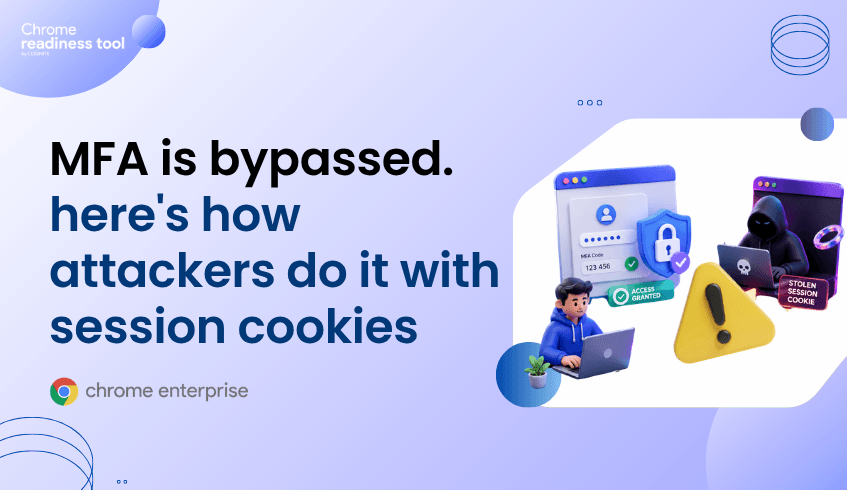
Session Tokens: Active session cookies that allow attackers to bypass login controls
Autofill Data: Personal and corporate information entered into forms
Downloaded Files: Sensitive documents temporarily stored on the device
Once extracted, this data can be used to access enterprise applications, impersonate users, or move laterally across systems.
Why Browser Data Is Highly Exposed
Browsers are designed for usability, which means they store and manage data locally to improve performance. However, this creates multiple exposure points:
Data is accessible at the device level, especially on unmanaged or BYOD endpoints
Malicious applications can attempt to read browser storage if protections are not in place
Users may unknowingly install extensions or software that introduce risk
Even a single compromised device can expose multiple applications, making browser-level protection essential.
Chrome Enterprise Premium: Protecting Against Data Extraction
Chrome Enterprise Premium (CEP) introduces protections specifically designed to reduce the risk of credential theft and data extraction:
App-Bound Encryption: Restricts access to browser data so only the browser itself can read it, preventing external applications from extracting credentials or session data
Protection Against Infostealers: Blocks unauthorized access attempts to sensitive browser storage
Policy-Based Controls: Ensures consistent protection across managed, unmanaged, and contractor devices
These controls help limit the ability of malware to extract usable data, even if a device is compromised.
Using Chrome Readiness Tool to Identify Risk Exposure
Before enforcing protections, IT teams need to understand where risks exist across their environment. The Chrome Readiness Tool, through its Browser Insights feature, provides visibility into potential exposure points.
Browser Insights helps identify:
Risky Extensions: Unverified or outdated extensions that may introduce vulnerabilities
Session Theft Vulnerability: Devices where session theft is possible, increasing exposure to credential misuse
Unsecured Domain Access: Visits to non-HTTPS or restricted domains that may expose sensitive data
This information is presented in the Browser Security Insights dashboard, where each device is evaluated based on these risk indicators. Devices are marked Secure only when no unverified extensions or risky domain activity is detected.
Administrators can drill down further to view device-level details, including installed extensions and browsing activity. This helps pinpoint where sensitive data may be exposed or at risk of extraction.
Where CEP Accelerator Adds Value
The CEP Accelerator, within Browser Insights, helps IT teams interpret these findings in the context of credential theft risk.
It provides clarity on:
Which devices are more likely to expose browser-stored credentials
How extension risk and browsing behavior contribute to potential data extraction
Which CEP protections, such as app-bound encryption, address these risks
Rather than just presenting raw data, it connects exposure points to the specific controls that reduce them.
From Visibility to Protection
Organizations can take a structured approach to mitigating infostealer risk:
Assess: Use Browser Insights to identify risky extensions, unsecured browsing, and session vulnerabilities
Analyze: Leverage CEP Accelerator to understand how these risks relate to credential exposure
Protect: Apply app-bound encryption and CEP policies to secure browser data
Monitor: Continuously track device posture and maintain protection coverage
This approach ensures that protections are applied where they are most needed, reducing both risk and operational disruption.
Conclusion
Infostealer malware targets one of the most valuable assets in the enterprise: browser data. Without proper controls, credentials, session tokens, and sensitive information can be extracted and misused.
With Chrome Enterprise Premium, organizations can prevent unauthorized access to browser data through app-bound encryption. With Chrome Readiness Tool’s Browser Insights, they gain visibility into where risks exist.
The addition of CEP Accelerator bridges the gap between insight and action, helping IT teams prioritize and apply protections effectively.
Start by identifying where your browser data is exposed, then use CEP to secure it before attackers do.