Is Your Browser a Security Blind Spot? 5 Hidden Costs of Legacy Management
The modern workplace has shifted significantly toward browser-based operations, where employees access business-critical applications, internal systems, and sensitive data directly through web sessions. From finance platforms to SaaS tools and internal dashboards, the browser now serves as the central hub for daily work and authenticated activity.
Despite this transformation, many organizations still rely on legacy, on-premises browser management practices that were built for a different IT landscape. These traditional methods lack the agility and visibility required to address evolving security threats, often resulting in operational gaps and increased risk. As enterprise environments continue to move toward the cloud, outdated browser management approaches can hinder both security effectiveness and overall operational efficiency.
Chrome Enterprise Premium provides a proactive alternative. By moving security controls directly into the browser, organizations can prevent threats before they reach internal systems. Chrome Enterprise Premium delivers granular control, contextual access, and centralized visibility to reduce risk while improving IT efficiency.
Modern Browser Security with Chrome Enterprise Premium
Chrome Enterprise Premium protects sensitive activity at the browser level with multiple capabilities:
Granular Data Loss Prevention: Control actions such as copy, paste, download, and print for sensitive data.
Real-Time Threat Protection: Block phishing sites and scan files for malware before they can impact devices or the network.
Context-Aware Access Controls: Restrict access to critical SaaS and private web applications based on device posture, user identity, and location.
Deep Malware Scanning: Automatically scan unknown or high-risk files before they enter the environment.
Centralized Security Insights: Gain visibility into risky user behavior and sensitive data movement for immediate action.
These features transform the browser from a passive tool into a controlled security boundary that enforces enterprise policies consistently.
Hidden Financial Costs of Legacy Browser Management
Organizations without premium browser controls often face five hidden costs that drain IT budgets:
Exploding Service Desk Tickets: Managing multiple browser versions leads to compatibility issues and frequent support requests.
Shadow IT Extension Tax: Employees install unverified extensions, creating a security risk and requiring expensive remediation.
Inefficient Application Testing: IT spends excessive time validating internal applications across multiple browser versions.
VPN Infrastructure Overhead: Remote workers routed through VPNs for basic access increase latency and require costly maintenance.
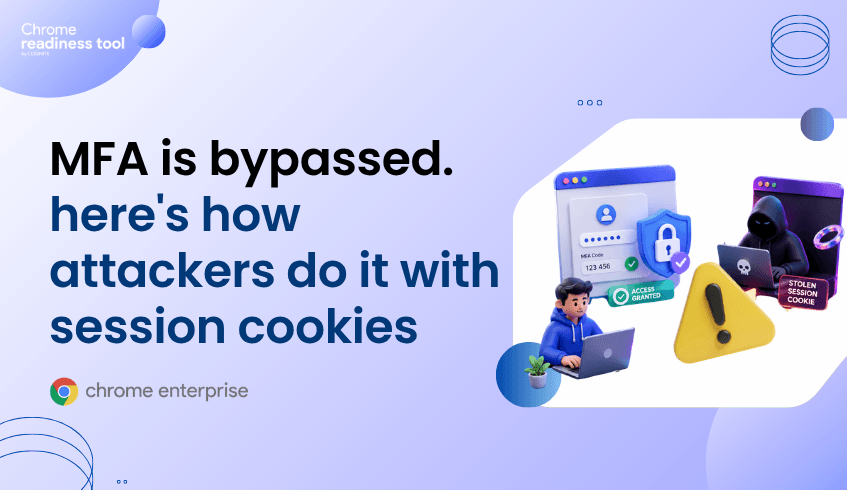
Session Hijacking Exposure: Traditional security may miss session theft attacks. Recovering from an incident can cost millions in financial loss and reputational damage.
Measuring Risk with the Chrome Readiness Tool
The Chrome Readiness Tool provides visibility into browser posture across the organization, allowing IT teams to take informed action. Key insights include:
Session Theft Indicators: Identify where active sessions could be compromised.
Unverified Extensions: Track unmanaged or high-risk add-ons.
Browser Sprawl: Map all browsers and versions across the fleet to pinpoint management overhead.
Device Security Distribution: Visualize secure and at-risk devices to prioritize remediation.
This insight helps organizations quantify risks and operational costs before enforcing new policies.
From Insight to Enforcement
Chrome Enterprise Premium and the Chrome Readiness Tool work together to establish a structured governance lifecycle:
Identify Exposure: Determine where browser risks exist.
Quantify Risk: Measure operational inefficiencies and security gaps.
Apply Policy Controls: Standardize configurations and enforce enterprise policies.
Monitor Continuously: Track compliance and posture over time.
Legacy browser management is no longer sufficient. It introduces operational inefficiency, hidden costs, and security gaps. By combining measurable insight with enforceable controls, organizations reduce unnecessary expenses, strengthen security, and ensure that the browser functions as a reliable, governed workspace for modern work.