Session Theft Protection with Chrome Enterprise Premium
Securing the Modern Browser Session
In today’s enterprise environment, the browser is the primary access point to business-critical applications. Finance systems, SaaS platforms, internal dashboards, and collaboration tools all run inside authenticated browser sessions that provide direct access to sensitive data.
That session is not just a technical layer. It represents active trust.
As hybrid work expands and SaaS adoption increases, protecting the browser session becomes a strategic priority. Traditional security models emphasize identity verification at login. However, once authentication is complete, the live session itself becomes a high-value target.
Chrome Enterprise Premium strengthens security at the point where work actually happens, inside the browser. It introduces centralized policy enforcement, contextual access controls, and structured governance across user sessions. Instead of relying only on identity-layer protections, organizations can secure the environment where authenticated activity operates.
How Chrome Enterprise Premium Enhances Session Security
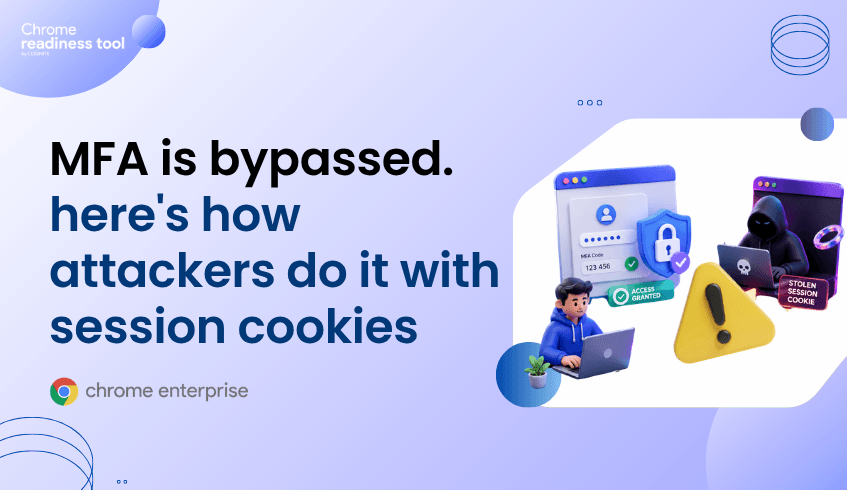
Session theft occurs when attackers hijack an authenticated browser session, bypassing login controls without needing credentials. In many cases, identity systems do not detect this because authentication technically already succeeded.
Chrome Enterprise Premium complements identity and endpoint protections by adding structured browser-level controls.
Context-Aware Controls
Administrators can apply policies based on device posture, user context, and organizational standards. This reduces the risk of unauthorized session reuse and limits exposure when a device falls outside compliance thresholds.
Centralized Governance
Security teams can enforce consistent browser configurations across distributed environments. This minimizes policy drift and removes inconsistencies that create exploitable gaps.
Risk-Based Access Enforcement
Browser-level controls aligned with enterprise policy reduce exposure during active sessions, especially when users interact with sensitive SaaS applications. Access decisions reflect context, not just credentials.
A Managed Browser Surface
The browser shifts from being a passive conduit to a governed security surface. Configurations are standardized. Controls are enforced. Risk is systematically reduced.
This approach moves session protection from reactive monitoring toward structured prevention.
Why Session Visibility Still Matters
Enforcement is critical, yet many organizations lack clear insight into where session-related risks are emerging across their environment.
Before strengthening policy controls, IT and security teams often need clarity:
Where are session risks concentrated?
How many devices show elevated exposure?
Are certain domains or user groups more vulnerable?
What is the distribution between secure and unsecured devices?
Without visibility, enforcement becomes assumption-driven. Visibility turns risk into measurable data.
The Role of Chrome Readiness Tool
The Chrome Readiness Tool provides a consolidated view of browser-related risks, including session theft indicators across installed devices.
Within its web dashboard, teams can identify:
Devices potentially exposed to session-related threats
Organization-wide risk metrics tied to browser usage
This visibility does not replace enforcement. It strengthens decision-making.
For many enterprises, the Chrome Readiness Tool becomes the analytical starting point. It quantifies exposure and highlights configuration gaps that may not be visible through traditional endpoint reporting.
A Structured Path from Insight to Protection
Chrome Enterprise Premium and the Chrome Readiness Tool serve complementary roles in a modern browser security strategy.
Chrome Enterprise Premium delivers:
Policy enforcement
Browser governance
Context-aware security controls
Standardized configurations
Chrome Readiness Tool delivers:
Risk visibility
Exposure mapping
Migration readiness insights
Together, they create a practical lifecycle.
Session theft is not only a technical threat. It is a governance challenge that requires measurable visibility and consistent enforcement.
By combining insight with browser-level controls, organizations transform the browser from a potential vulnerability into a managed security boundary.