What the CEP Accelerator Actually Shows You
Chrome Enterprise Premium covers a lot of ground. DLP, phishing protection, context-aware access, URL filtering, extension management, security reporting. For IT teams evaluating CEP, the features aren't hard to find. What's harder is knowing which ones matter most for your specific environment right now.
That's the gap the CEP Accelerator is designed to close.
Not a Feature List. A Visibility Layer.
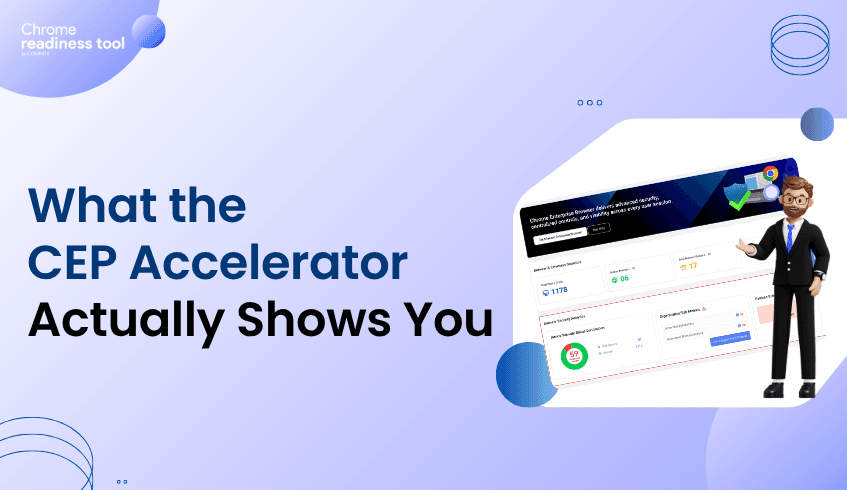
The CEP Accelerator isn't a tour of what CEP can do in general. It's a targeted view of where your environment has the highest exposure and how CEP's premium capabilities map directly to those gaps.
It lives inside the Chrome Readiness Tool and works from the same environment data the Chrome Readiness Tool analyzes. The difference is what it does with that data.
Instead of stopping at "here are your risks," the CEP Accelerator goes one step further: here are the risks, and here's the specific CEP capability that addresses each one.
What It Surfaces
The CEP Accelerator focuses on the areas where the jump from Chrome Enterprise to Chrome Enterprise Premium has the most practical impact.
Extension risk is one of the clearest examples. The Chrome Readiness Tool identifies unverified or high-risk extensions across your fleet. The CEP Accelerator connects that finding to CEP's extension auditing and enforcement capabilities, showing you what controlled extension management would look like in your environment specifically, not just in theory.
Session theft protection is another. The Chrome Readiness Tool shows whether each device is protected against session theft based on whether DBSC policy is active through Chrome Enterprise Premium. If CEP isn't active on a device, that device shows up as unprotected. It's a direct, device-level signal. The CEP Accelerator takes that visibility and maps it to the CEP activation that would change that status, so you can see exactly how much of your fleet is exposed and what it takes to close it.
The same logic applies to data protection gaps and phishing exposure. The Accelerator takes each risk category and ties it to the CEP feature that resolves it.
Why This Matters for IT Teams
The most common friction point in a CEP evaluation isn't budget or buy-in. It's clarity. IT teams need to be able to answer: which features do we actually need, and what will they fix?
The CEP Accelerator answers that question with your own data rather than a generic product overview. That's a fundamentally different kind of conversation to have with a decision-maker.
Instead of saying "CEP protects against session theft," you can say "here's how many devices in our fleet currently show as unprotected because DBSC policy isn't active, and here's what enabling CEP changes." That level of specificity is what moves projects forward.
What It Doesn't Do
It's worth being clear about scope. The CEP Accelerator is a visibility and planning tool. Session theft protection status, for example, reflects whether DBSC policy is active through CEP, it's a policy coverage indicator, not a real-time attack monitor. What the tool gives you is an accurate picture of where your devices stand today and which CEP capabilities would change that.
The value isn't in alerting. It's in connecting your actual environment to the right premium capabilities before you deploy, so you're not guessing at configuration priorities after the fact.
CEP Accelerator: Now Available in Chrome Readiness Tool
The CEP Accelerator is now live inside the Chrome Readiness Tool. Run an assessment, open the Accelerator, and you'll see your environment mapped against CEP's premium features in a way that makes deployment decisions significantly easier to justify and act on.