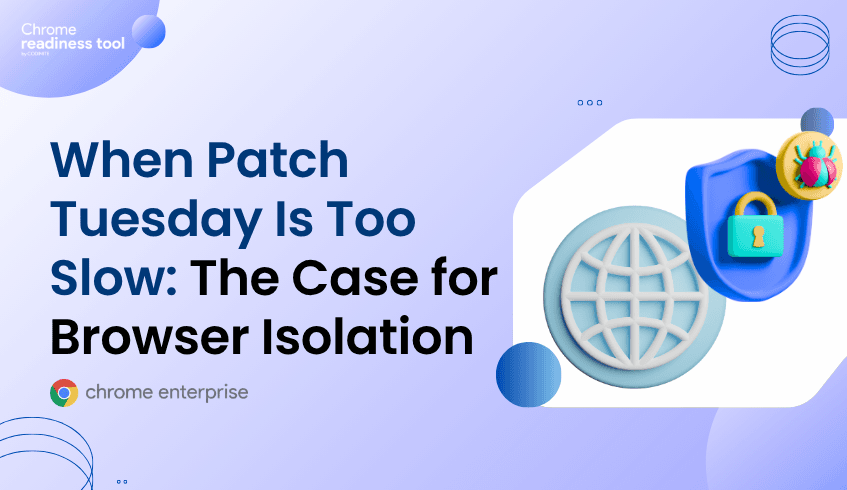
When Patch Tuesday Is Too Slow: The Case for Browser Isolation
The Widening Window Between Discovery and Patch
The enterprise patch cycle was designed for a different threat environment. Monthly patch cycles made sense when vulnerability discovery was manual, slow, and resource-intensive. AI-assisted vulnerability research has changed that timeline fundamentally. Security researchers and threat actors alike can now identify exploitable flaws in browser engines, rendering components, and JavaScript environments at a pace that outstrips the traditional 30-day patch window.
For enterprise security teams, this creates a structural exposure problem. Between the day a vulnerability is identified and the day an enterprise can validate, package, and deploy a patch across a managed fleet, attackers can be actively exploiting that vulnerability against unpatched browsers. The browser, as the primary workspace for enterprise data access, SaaS application use, and credential handling, represents the highest-value target in this window.
Browser isolation addresses this gap not by accelerating the patch cycle but by reducing what an attacker can accomplish while that window is open. It is a risk reduction strategy for an era in which patch timelines and discovery timelines are fundamentally mismatched.
Where the Risk Comes From
Zero-day and near-zero-day browser vulnerabilities are being discovered faster than enterprise patch cycles can respond, leaving known-vulnerable browsers in production use
Browser engine exploits can provide direct access to session tokens, credential stores, and application data without requiring the attacker to compromise the endpoint separately
Outdated browsers running in managed fleets continue to access sensitive enterprise applications during the patch window, expanding the blast radius of unpatched vulnerabilities
AI-generated proof-of-concept exploits reduce the technical barrier for operationalizing newly discovered vulnerabilities before patches are available
Data exfiltration through browser-based exploits bypasses endpoint detection tools that are not positioned to inspect in-browser processes
Chrome Enterprise Premium: Isolation and Enforcement as a Risk Reduction Layer
Chrome Enterprise Premium provides browser-level controls that reduce the impact of unpatched vulnerabilities without requiring a patch to be deployed. Site isolation enforces process separation between different web origins, limiting the scope of what a successful browser exploit can access within a single session. This architectural control operates independently of whether the browser has received the latest security patch.
CEP's Safe Browsing integration and real-time URL classification prevent browsers from reaching the delivery infrastructure that exploit campaigns typically rely on. Even in a window where a browser vulnerability is known and unpatched, CEP's network-layer enforcement reduces the likelihood of successful exploitation by blocking access to the domains and resources used to deliver browser-targeted payloads.
App-bound encryption protects credential and session data from extraction even when a browser process has been partially compromised, limiting the post-exploitation value of a successful browser-level attack.
Understanding Risk with Chrome Readiness Tool
Browser Insights makes the patch gap visible at the device level. The tool assesses session theft vulnerability based on browser version, clearly distinguishing devices running current and protected browsers from those running outdated and not protected versions. This distinction is critical during any period when a known vulnerability is unpatched across the fleet.
Extension security is also surfaced within Browser Insights. Unverified and outdated extensions represent additional attack surface that can be exploited in combination with browser engine vulnerabilities. The tool covers Chrome, Edge, Firefox, Vivaldi, Brave, and Opera, providing fleet-wide visibility rather than a single-browser view.
Access to unsecured domains is a further risk signal, as non-HTTPS and restricted domains are frequent exploit delivery channels. A device is considered secure when it presents no unverified extensions and no access to restricted domains.
Where CEP Accelerator Adds Value
CEP Accelerator is a planning layer inside Browser Insights. It connects the risk signals surfaced by Browser Insights, specifically outdated browser versions and unverified extension exposure, to the CEP capabilities that mitigate patch-window risk.
During a period of known browser vulnerability, CEP Accelerator helps security teams identify which devices are most exposed and which CEP controls should be prioritized for rapid deployment. It turns the visibility provided by Browser Insights into a concrete enforcement action plan that does not wait for the patch to be available.
Reducing Exposure When the Patch Is Not Ready
Browser isolation and policy enforcement are not substitutes for patching, but they are essential for the period when a patch is not yet deployed. Chrome Enterprise Premium provides the controls that reduce exploitability and limit post-exploitation impact. Browser Insights identifies where those controls are most urgently needed.
Start by identifying risks with Browser Insights to understand which devices in your fleet are most exposed during the current patch window.