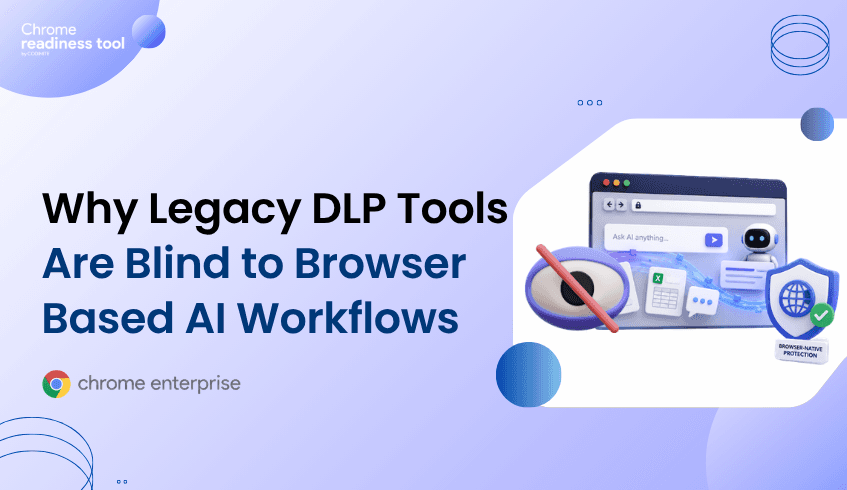
Why Legacy DLP Tools Are Blind to Browser-Based AI Workflows
AI workflows are increasingly happening inside the browser, where employees research, summarize, paste, upload, copy, and move data across SaaS tools and generative AI applications. Legacy DLP tools were not designed for this kind of fast, browser-native, AI-assisted work. They often focus on files, endpoints, email, or network traffic, while missing the context of what users are doing inside authenticated browser sessions. Browser Insights helps security teams identify browser and extension risk across the fleet. Chrome Enterprise Premium brings threat and data protection closer to the browser, while CEP Accelerator helps teams prioritize where to deploy Chrome Enterprise Premium based on observed browser risk.
The AI Workflow Has Moved Into the Browser
Enterprise DLP was built for a world where data moved through predictable channels: email attachments, file shares, USB drives, managed endpoints, and sanctioned cloud storage. That world still exists, but it is no longer the whole picture.
Modern employees now work across web applications, SaaS tools, cloud dashboards, developer environments, collaboration platforms, and AI assistants through the browser. They paste customer data into prompts, upload documents for summarization, copy generated output into business systems, and move between sanctioned and unsanctioned tools in the same session.
This creates a new problem for security teams: the browser has become the place where sensitive data is transformed, not just transferred.
A legacy DLP tool may see a file upload or a network request. It may inspect an email attachment. It may block a known sensitive document from leaving a managed endpoint. But browser-based AI workflows are more fluid. Data can be copied from one SaaS application, pasted into an AI tool, summarized, rewritten, exported, and reused somewhere else within minutes.
The risk is not only data exfiltration. It is loss of control over where sensitive data goes, how it is transformed, and whether the organization can see the browser conditions that made the exposure possible.
Why are browser-based AI workflows hard for legacy DLP?
Browser-based AI workflows are hard for legacy DLP because they happen inside an interactive, authenticated, user-driven environment.
Traditional DLP often looks for sensitive data at known control points. It watches file movement, email flows, endpoint storage, cloud uploads, and network traffic. AI workflows in the browser do not always follow those patterns.
A user may copy sensitive content from a CRM record and paste it into a web-based AI assistant. Another user may upload a spreadsheet to a summarization tool. A developer may paste source code into an AI coding assistant. A finance user may ask an AI application to analyze confidential numbers. In each case, the action may look like normal browser activity unless the control understands the browser context.
Legacy tools can struggle because they may not know:
Is the user copying data from a sensitive web app?
Is the paste destination sanctioned or unsanctioned?
Is the browser current and protected?
Are unverified extensions present in the same browser environment?
Is the destination a restricted, non-HTTPS, or suspicious domain?
Is the data being uploaded, pasted, downloaded, printed, or transformed?
These details matter. AI workflows are not just about where data is stored. They are about how data is used inside the browser.
How do attackers and risky workflows exploit the gap?
The gap appears when browser activity looks normal to legacy controls but creates real data exposure.
An employee may use an AI tool to speed up work without realizing that sensitive data is being shared outside approved systems. A browser extension may introduce additional exposure by interacting with page content. An outdated browser may increase session theft risk. A non-HTTPS or restricted domain may create unsafe browsing conditions. A user may access multiple AI services from the same browser profile that also holds authenticated sessions for critical enterprise applications.
Not every exposure is malicious. Many are productivity-driven. But the security outcome can be the same: sensitive data moves into places where the organization has limited visibility and limited control.
Attackers can take advantage of the same blind spot. If a browser session is exposed, or if an unsafe extension has access to page content, the attacker may be closer to the data than a network-based DLP tool can see. If a user is redirected to a risky AI-themed site or phishing page, the activity may appear as ordinary web browsing until the data has already left the protected environment.
This is why browser context is essential. Security teams need to understand not only that data moved, but what browser, device, extension, session, and destination were involved.
Why traditional DLP controls fall short
Legacy DLP tools are still useful, but they were not designed to govern every action inside a modern browser session.
The first limitation is context. A network or endpoint control may see that data moved, but not always understand the user’s browser posture, the risk level of the destination, or whether the action occurred inside a sensitive web app.
The second limitation is workflow granularity. Browser-based AI work involves copy, paste, upload, download, print, screenshot, prompt entry, and response reuse. A tool that only evaluates files or outbound traffic may miss the smaller interactions that create exposure.
The third limitation is browser diversity. Many enterprises run multiple browsers across managed and unmanaged devices. Without browser-level inventory, it becomes difficult to know where exposure is concentrated.
The fourth limitation is extension risk. Extensions can change what happens inside the browser. They may request broad permissions, interact with page content, or create pathways that are difficult to evaluate through traditional DLP alone.
The result is a visibility and enforcement gap. Sensitive data increasingly moves through the browser, while many DLP programs still focus on control points outside the browser.
Chrome Enterprise Premium: Bringing DLP into the browser
Chrome Enterprise Premium helps address this gap by applying security closer to where browser-based AI workflows happen.
Chrome Enterprise Premium is Google Cloud’s secure enterprise browsing solution, providing advanced, integrated security directly within the browser. It delivers centralized management, threat and data protection, and Zero Trust access controls for web applications. Google’s documentation describes Chrome Enterprise Premium as helping defend against real-time phishing and malware, prevent data exfiltration with granular DLP policies, and enforce Context-Aware Access to apps directly in Chrome.
This matters for AI workflows because users interact with AI tools through the browser. Chrome Enterprise Premium extends data loss prevention protections into browser activity, helping organizations control actions such as copying, pasting, downloading, and printing.
Google also describes Chrome Enterprise Premium capabilities including content inspection, data loss prevention, anti-malware, anti-phishing, dynamic URL filtering, and site categorization.
For enterprises, the value is not that browser DLP replaces every existing DLP tool. The value is that it protects the control point legacy DLP often misses: the browser session itself.
How does browser-level DLP change AI security?
Browser-level DLP changes AI security by placing controls where users take action.
Instead of waiting until data leaves through a traditional channel, browser-level controls can help govern copy and paste, uploads, downloads, printing, and access to risky destinations inside the browser workflow. This is especially important when employees use AI tools to summarize documents, generate content, analyze spreadsheets, or transform sensitive information.
Chrome Enterprise Premium can help organizations apply more granular policy around browser activity. For example, a company may want to restrict copying sensitive data from a protected application into an unauthorized AI tool. It may want to reduce access to risky AI-themed domains. It may want better visibility into unsafe downloads or web destinations. It may want to enforce access controls based on user and device context.
This moves security closer to the moment of risk.
That is the key difference between legacy DLP and browser-native protection. Legacy DLP often reacts to data movement after it is packaged, transmitted, or stored. Browser-level protection can help govern the user interaction before the data becomes harder to control.
From Chrome Readiness Tool: Understanding browser exposure across the fleet
Browser Insights, the Chrome Readiness Tool, gives security teams device-level visibility into browser and extension risk across the enterprise fleet.
This visibility matters because AI workflow risk is not only about which AI tools employees use. It is also about the browser environment where those tools are accessed.
Browser Insights surfaces browser and extension details including browser name, browser version, and installed extensions across Chrome, Edge, Firefox, Vivaldi, Brave, and Opera. This helps security teams understand browser diversity and identify inconsistent posture across the fleet.
For browser-based AI workflows, the most relevant risk signals include session theft vulnerability based on browser version, unverified extensions, and access to restricted or non-HTTPS domains.
Outdated browsers are flagged as not protected, while current versions are confirmed as protected. Unverified extensions are surfaced because they can increase exposure inside the browsing environment. Restricted or non-HTTPS domains are important because unsafe destinations can become part of risky AI workflows, phishing paths, or data movement patterns.
A device is considered secure within Browser Insights when it has no unverified extensions and no access to restricted or non-HTTPS domains. Device-level drill-down helps teams investigate specific machines where browser risk is elevated.
For AI workflow governance, this is the visibility foundation. Before security teams can apply the right browser-level controls, they need to know which devices and browser conditions create the most exposure.
Where CEP Accelerator adds value
CEP Accelerator helps teams move from browser visibility to deployment prioritization.
Inside Browser Insights, CEP Accelerator acts as a planning and visibility layer. It does not enforce policies or detect attacks directly. Instead, it maps observed browser risks to relevant Chrome Enterprise Premium capabilities that can help address them.
For browser-based AI workflows, CEP Accelerator can help connect findings such as outdated browser versions, unverified extensions, and risky domain access to Chrome Enterprise Premium controls for stronger session protection, extension governance, secure browsing enforcement, and browser-level data protection.
This helps security teams prioritize action. A device with unverified extensions and access to unsafe domains may represent a higher priority than a device with fewer browser risk signals. A business unit using multiple AI tools through outdated browsers may require faster attention than a lower-risk group.
CEP Accelerator turns browser risk visibility into a practical deployment roadmap. It helps teams decide where Chrome Enterprise Premium can deliver the most value first.
Closing CTA
Legacy DLP cannot protect what it cannot see. As AI workflows move deeper into the browser, security teams need browser-level visibility and browser-level enforcement. Start with Browser Insights to identify exposed browsers, unverified extensions, and risky domain access. Then use CEP Accelerator to prioritize where Chrome Enterprise Premium can help close the browser-based AI workflow gap first.